
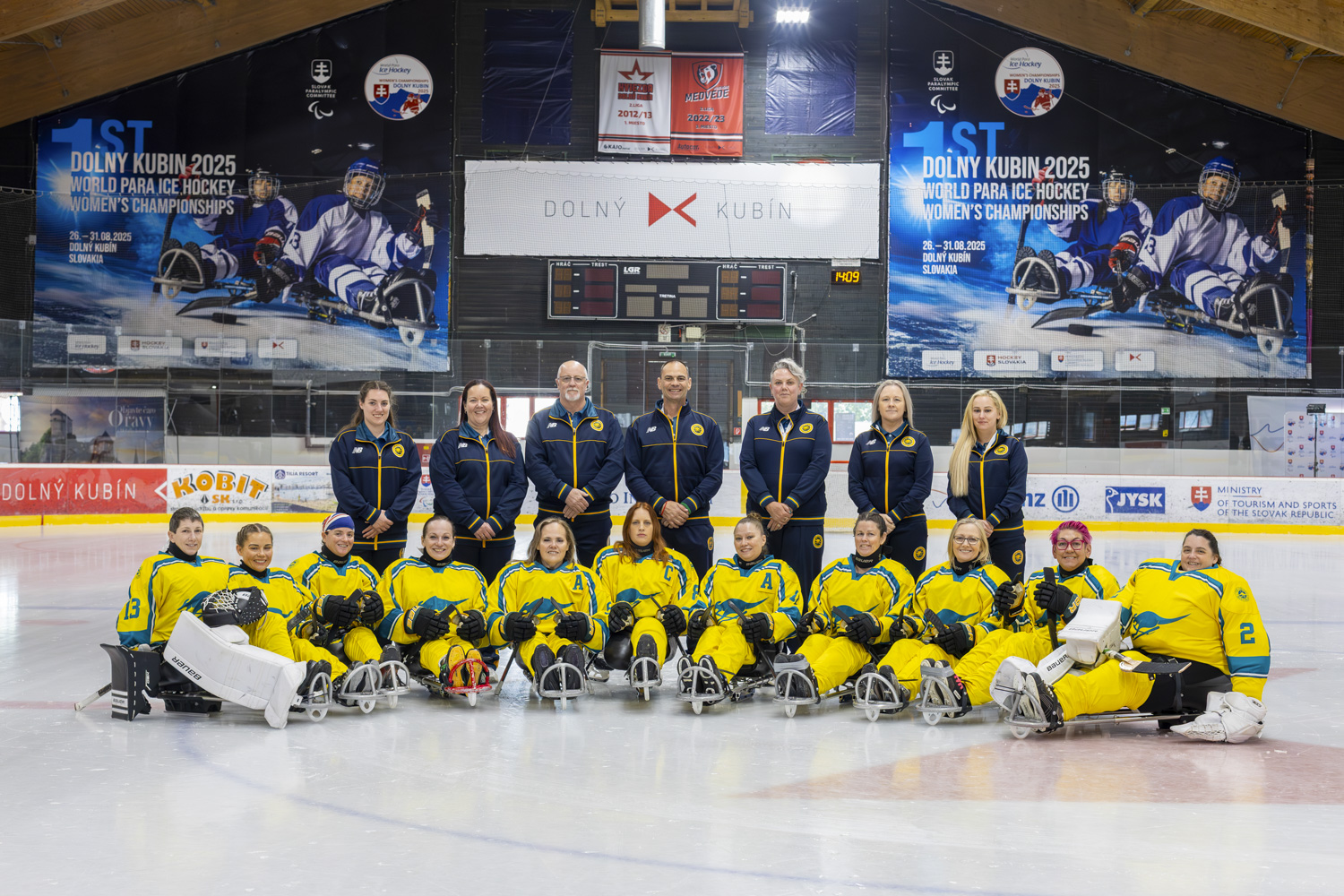
When I rolled into Stadium Australia at the Sydney 2000 Paralympic Games, I thought I’d lived the sporting dream. I was a young Australian Paralympian with a throwing circle at my feet and a crowd that roared like the ocean. Two and a half decades later, I’ve laced up a very different dream: trading discus and shot put for carbon-fibre sticks, steel sled runners and the cold bite of a Slovakian rink.
This is the story behind our history-making first step: Australia’s debut at the inaugural Women’s Para Ice Hockey World Championships in Dolný Kubín, Slovakia. We didn’t fly across the world because we were certain to win. We went because we’re certain this is where Australia’s future in winter para sport begins.

More...
Why We Went Before We Felt “Ready”
We entered the championship knowing we were building as we skated. Half of our team were brand new to the sport, with only months on the ice. It would have been easy to sit out, to wait until everything was perfect—more ice time, more funding, more experience. But sometimes you don’t get to wait for the world to turn in your favour. Sometimes you step forward and become the reason it turns.
Historically, the Paralympics offers a mixed division in para ice hockey and only three women have ever been selected to Paralympic teams. Australia has never fielded a Paralympic para ice hockey team. Our presence in Dolný Kubín wasn’t just about 2025; it was about 2030. If we want to see a women’s team in a future Winter Paralympics, we have to show the pathway now—gather evidence, build athletes, and prove that Australian women’s para ice hockey is real, determined and here to stay.

The Result That Matters: Lessons Over Scorelines
We didn’t win a single game. That’s the sentence people sometimes pause on. But here’s the rest of it:
We learned the rhythm of elite international play—how it feels to start fast, reset after a goal against, and manage pressure shifts.
We learned how to communicate on the bench and on the ice, to read lanes, protect the slot and break out with purpose.
We learned how to lose like winners—with grace, grit and a notebook full of adjustments for next time.
Each match became a living classroom. We left with dozens of film clips to study, a clearer conditioning plan, and a smart list of technical gaps—face-off structure, controlled exits, and defensive spacing—that we’ve already begun to fix.

What Para Ice Hockey Feels Like (From the Sled)
Para ice hockey is fast, tactical and relentless. Your sled becomes part of you—two blades under a bucket seat, a low centre of gravity, and your whole world about 10cm above the ice. You propel with two short sticks, each with picks in the butt end and curved blades for shooting and passing. Your shoulders work harder than you imagined; your core becomes a metronome; your eyes scan the ice like radar.
The first thing you learn is to trust the edges of your runners, to pivot into space, and to absorb contact safely. The second thing is to breathe—because the game moves in bursts and you need to reset between shifts. The third is joy: that moment when a clean pass threads a lane and you feel the play unfold because you made it happen.

Building a Team on the Fly—Logistics, Access and Culture
Success is never just skill. It’s logistics, access and culture:
Ice time is precious in Australia. We planned smarter, using high-intensity sessions, targeted drills and off-ice strength work to compress learning.
Accessibility matters. From travel to dressing rooms to sled maintenance, every detail can open or close doors for disabled athletes. We documented the friction points and are already advocating for better standards.
Culture makes or breaks you. We kept standards high and egos low. We celebrated small wins (a cleaner breakout, a stronger second period), and we debriefed—honestly—after every game.
We also leaned into community: family, friends, volunteers and supporters who understand that firsts are never tidy. They’re bold, occasionally messy, and absolutely necessary.

The Long Game: A Roadmap to 2030
We’re not waiting for another invitation to believe we belong. Our roadmap is clear:
Skill Density
Increase the baseline skill of every player—puck control, escape moves along the boards, under-pressure passing—and build two-player and three-player patterns that travel well against international defence.Conditioning for Contact
Sled-specific strength for shoulders and lats, rotational core work for balance and shot power, and energy systems training to support fast 45–60 second shifts.Game IQ
System consistency—forecheck schemes, neutral zone traps, special teams—and scenario repetition (protecting a one-goal lead, chasing a game, last-minute 6-on-5).Depth and Talent Pathway
Recruitment of new athletes across Australia, especially women and girls with competitive backgrounds (wheelchair basketball, wheelchair rugby, athletics, swimming). We’ll run “try sled” days and regional camps to widen the funnel.Sustainable Infrastructure
Partnerships with rinks and community clubs, coach development, officiating education, and equipment funds so sleds and blades don’t become barriers.International Exposure
Regular fixtures and camps with established teams. You don’t close the gap by watching; you close it by playing.

Why Representation on Ice Matters
For years, the official story in para ice hockey has been that women are welcome—technically. In practice, very few have been selected for mixed teams at the Paralympics. Visibility is a lever. When young disabled women in Australia see us in national colours, hear our accents in post-game interviews, and watch us line up for an anthem far from home, they realise that this story includes them.
We showed up in Dolný Kubín to move the needle, to help make women’s para ice hockey visible, competitive and undeniably Australian.

The Human Side of a First
Away from the scoreboard, there were moments that will stay with me:
- Pushing through the crowd and feeling the whole group rearrange to make space—inclusion in motion.
- The first time a new player cleanly won a board battle against a veteran opponent and skated out smiling through her visor.
- The change room where we debriefed tactics and supported each other as we dressed and prepared.
- The quiet of the rink before warm-up, when you can hear the cutters on the Zamboni and know you earned your way onto this ice.
These are the stitches that hold a debut together.

What We Took Home
We returned to Australia with more than jerseys and bruises. We brought back:
- Data—shift lengths, puck recoveries, zone exits.
- Clarity—which systems suit our current strengths, which we’ll build into.
- Belief—that we can turn lessons into wins, and wins into a programme that lasts.
We didn’t win a single game, but we learnt the ropes and we have the desire to keep going. That’s not a consolation prize; it’s the blueprint.

How You Can Help
- Athletes: Come and try. If you’ve got competitive fire and a willingness to learn, we have a sled for you.
- Rinks & Clubs: Partner with us on ice slots and community days.
- Sponsors & Grants: Help us fund sleds, travel and coach development.
- Fans: Share our story. Visibility changes everything.

FAQs
Q1: What is para ice hockey?
Para ice hockey (also called sledge hockey) is the Paralympic version of ice hockey. Players sit on sleds fitted with two blades and use two short sticks—both to propel and to play the puck. It’s fast, physical and brilliantly tactical.
Q2: Where is Dolný Kubín and why does it matter?
Dolný Kubín is a town in northern Slovakia. It hosted the first-ever Women’s Para Ice Hockey World Championships, making it a landmark moment for our sport—and the perfect stage for Australia’s debut.
Q3: Did Australia win any games?
No. We didn’t take a win this time. But we gained what we came for: experience, film, systems, confidence—and a plan to turn lessons into results.
Q4: How can women in Australia try para ice hockey?
Reach out via my page at www.lyndaholt.com.au, info@lyndaholt.com.au or your local para sport networks. We’re running “come and try” sessions and building a national pathway. New players are very welcome.
Q5: What’s the goal for 2030?
A robust Australian women’s programme with depth, coaching excellence and international experience—positioned for selection when a women’s division reaches the Paralympic stage.

Conclusion: From a Throwing Circle to a Blue Line
Sydney 2000 taught me about home-crowd thunder and the discipline required to be a Paralympian. Slovakia taught me about beginnings—how raw, honest and precious they are. From the throwing circle to the blue line, the lesson is the same: show up, do the work, build the future.
This was the first step. It won’t be the last. See you on the ice.
